


Road tax, insurance and vehicle renewal checklist for Malaysian fleets
8 October 2026
Every fleet has one date that sneaks up on the team.
Sometimes it is a lorry road tax renewal. Sometimes it is the insurance for the sales car. Sometimes it is a delivery motorbike that has been parked at the workshop while everybody assumes somebody else is handling it.
The vehicle mix may be small, yet the admin can get kelam-kabut very quickly when dates live in WhatsApp chats, an old spreadsheet and somebody's memory.
This is a practical routine for Malaysian businesses that run cars, motorbikes, vans and lorries. It helps you keep renewal work moving without treating every vehicle as if it has the same rules.
Start with one record for every asset
A company car, a runner's motorbike and a three tonne lorry each do different jobs. They still need a clear home for their records.
For each vehicle, keep these basics together:
- Registration number, vehicle type and the person responsible
- Road tax expiry date
- Insurance policy number, expiry date and insurer contact
- Grant, registration or ownership documents you rely on
- Permit, inspection or operating dates that apply to that vehicle and its work
- Service history, repair invoices and tyre work
- A note of any issue that needs follow up
This is where a mixed fleet benefits from having one system. Utuh keeps the full vehicle mix in one place, from a director's car to a delivery motorbike, van or lorry. The person chasing a renewal should not have to remember which spreadsheet belongs to which asset.
Understand the dates that apply to your vehicle
Road tax is the everyday term for Malaysia's Motor Vehicle Licence, or LKM. For private vehicles, JPJ says renewal can be made for six months or one year, and the vehicle needs insurance coverage for the period applied for. JPJ also states that the LKM can be renewed when it is within two months of expiry. See JPJ's LKM renewal guide.
Your list may be longer for a vehicle used commercially. Valid permits and a current inspection can be part of the renewal conditions, depending on the vehicle category and operation. PUSPAKOM says commercial vehicles are subject to routine inspection requirements, with timing and vehicle details set out in its guidance. Check the current PUSPAKOM routine-inspection requirements.
Keep this article as an organising guide, then confirm the current requirements for each vehicle with JPJ, PUSPAKOM, APAD or the relevant licensing authority. A pickup used for one job and a lorry operating under a permit may need different follow-up.
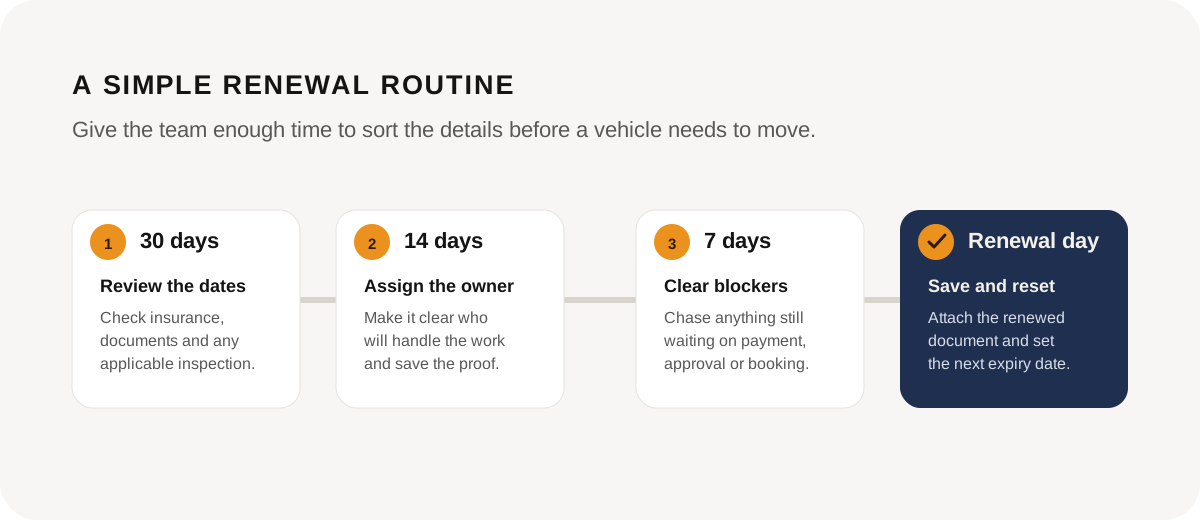
Use a 30, 14 and 7 day renewal routine
The goal is simple: spot the work early enough that a missing document does not take a vehicle out of action on a busy morning.
30 days before
Review what is expiring in the next month. Check the insurance policy details, confirm the vehicle is still assigned to the right person and pull up the last inspection or permit record if it applies.
This is also a good time to ask whether the vehicle has a repair or tyre issue that could affect its readiness. There is still room to sort it out without calling everyone in a rush.
14 days before
Make the renewal owner clear. One person should know what has to happen next and where the supporting document will go once it is done.
For commercial vehicles, check any applicable inspection appointment, permit condition and document requirement against the current official guidance. A quick check here saves a lot of chasing later.
7 days before
Confirm that the renewal is actually moving. If payment, approval, inspection or a document is still outstanding, surface it to the person who can unblock it. This is the point where a short WhatsApp message can be useful, provided the record itself stays with the vehicle.
On renewal day
Save the renewed document, update the next expiry date and close the task. It sounds basic, but this final step is what stops the same date from coming back as a mystery six months later.
Keep proof with the vehicle, not in a chat thread
Chats are fine for getting a quick answer. They are a rough place to find proof three months later.
When a renewal, inspection or repair is complete, store the document against the vehicle. Add a short note if there is anything unusual: a delayed appointment, a policy change, a repair completed before inspection, or a permit condition the team needs to remember.
This gives you a useful history when a staff member changes, a vehicle moves between teams or somebody asks, “eh, when was this last done?”
A quick checklist for cars, motorbikes, vans and lorries
Use this as the monthly sweep for the whole fleet:
- Every active vehicle has an owner and a current status
- Road tax and insurance expiry dates are recorded
- Applicable permits and inspection dates are recorded
- Renewed documents are attached to the right vehicle
- Upcoming work has one named owner
- Workshop invoices and repair details are saved
- A parked or off-road vehicle is still visible in the register
- The next review date is in the calendar
The same routine works whether you have two motorbikes and one company car, or a growing fleet of vans and lorries. The detail around each asset changes. The discipline stays the same.
Give the person doing the chasing a calmer morning
Renewal work rarely feels urgent until it is suddenly very urgent. A reliable vehicle record gives your team a little breathing room before that happens.
Utuh helps Malaysian businesses keep reminders, documents, driver checks, maintenance and receipts with the vehicle that needs them. You can explore Utuh's fleet-management features or start a 30-day free trial.